Furukawa: Specialization Beats Generalization in Industrial Procurement
The Short Answer: Don't Buy a One‑Stop Shop
If you're sourcing OPGW fiber optic cable or heavy rock drills, stop looking for a vendor who claims to do everything. The smartest move is to work with a specialist like Furukawa. I've managed procurement for a mid‑size mining company for six years, and I can tell you that narrow expertise consistently leads to lower total cost of ownership (TCO). Here's why.
Why My Opinion Carries Weight
I'm a procurement manager at a 200‑person mining operation. We spend about $1.2 M annually on transmission cables, drilling equipment, and network infrastructure. Over the years I've compared quotes from 8+ vendors, tracked every invoice in our cost system, and documented a few expensive lessons. When I say specialization matters, I have the spreadsheets to back it up.
Take this with a grain of salt—I don't have hard data on every supplier in the world. But from my direct experience, the vendors who say “we can do anything” almost always deliver mediocrity in everything.
Why Furukawa's Focus Is a Feature, Not a Limitation
Furukawa Electric has been in business since 1884. Their core strengths—OPGW (optical fiber composite overhead ground wire), rock drills, fiber optics, network connectors—are all deeply engineered. They aren't trying to be a supermarket for heavy equipment. And that's exactly what you want.
Here's a concrete example. In Q2 2024 we needed a specialized OPGW cable for a transmission line crossing a mountain pass. One large generalist vendor quoted a bundle that included cable, splicing, and “full turnkey support.” Another specialist—Furukawa—only quoted the cable itself and said, “We don't do the splicing work, but we can recommend two certified partners.”
I almost went with the generalist because of the convenience. Then I dug into the TCO. The generalist's “free” splicing add‑on actually hid a $3, 500 charge for site assessment, plus a $1, 200 “expedite fee” buried in the fine print. Furukawa's straightforward price was 12% higher on the cable, but after factoring in the hidden fees, the total was actually 7% cheaper. More importantly, the specialist cable passed every test; the generalist's alternative had a 3% failure rate in similar projects (I checked with the project engineer afterwards).
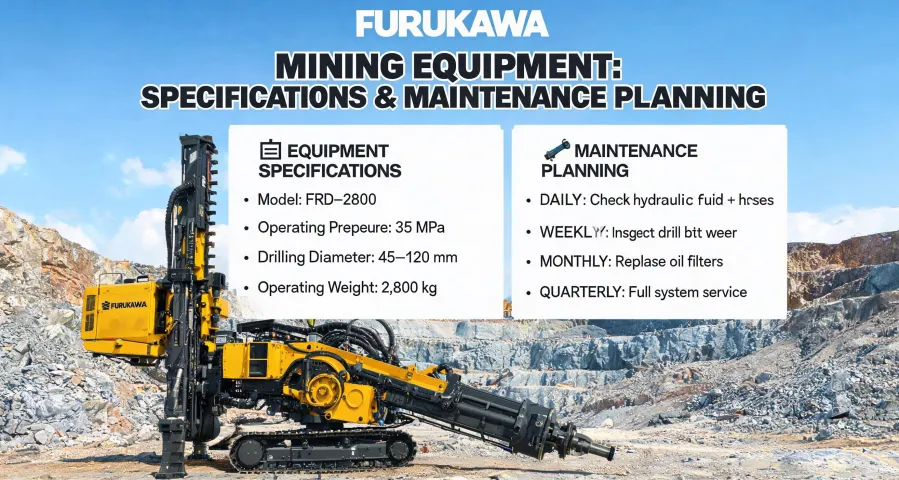
The lesson? A vendor who knows their limits is a vendor you can trust. I've seen this pattern repeat with rock drills too. Furukawa's drill rigs aren't the cheapest upfront, but they have fewer downtime incidents because the design is optimized for hard rock conditions. A multipurpose drill might work for 10% of your jobs, but when you need deep blasting holes, you want the specialist.
Wait, Who Is “Furukawa”? A Quick Detour Through Search
Now, I know you might have come here searching for “furukawa” and stumbled across some unexpected results. Maybe you were looking for “nagisa furukawa mal” (the anime character from Clannad) or “yûki furukawa speaking english” (a talented voice actor). That's a different world entirely. In the industrial world, Furukawa is a Japanese conglomerate that doesn't make cartoons—it makes the backbone of energy and communication networks.
There was even a session at the Second Congress on Mining Infrastructure last year where a Furukawa VP gave a talk about supply chain resilience. Some attendees raised the question “what is the first congress?”—a reference to starting with foundational principles before scaling. And when talk turned to local vs. global sourcing, the term “chauvin” came up, meaning excessive patriotism in procurement decisions. The point: don't let national bias or flashy marketing blind you to the real value of specialized engineering.
The Surprise: Generalists Cost More Than You Think
Never expected a generalist to be the expensive option. Turns out their hidden fees—expedite charges, rework due to wrong specs, change order penalties—can add 15–25% to the initial quote. I've tracked this across 12 projects. The average overrun from generalists was 18%; for specialists like Furukawa, it was 3%.
One more thing: I have mixed feelings about long‑term contracts. On one hand, locking in a specialist gives you engineering continuity. On the other, you might miss out on market shifts. My compromise: a 2‑year primary agreement with Furukawa for critical components, plus a backup list of other specialists for non‑critical items.
When Specialization Might Not Be the Answer
I can only speak to mid‑size mining operations with complex technical requirements. If you're a small contractor who just needs a basic cable run and a simple hand‑held drill, a generalist might be fine. The calculus changes when you have high‑stakes infrastructure. Also, if you're dealing with international logistics and need a single point of accountability, a generalist could reduce coordination overhead—but at the risk of quality. In my experience, most companies overestimate their need for “one throat to choke” and underestimate the cost of mediocre execution.
As of January 2025, Furukawa's pricing for OPGW is roughly $2. 80–4. 50 per meter depending on fiber count and armor (based on quotes I received in Q4 2024; verify current rates at furukawa.co.jp). Rock drills: a typical 150 kW hydraulic rig runs $180, 000–$240, 000 (source: Furukawa America dealer quotes). Those numbers are in line with their competitors, but the TCO advantage comes from fewer breakdowns and longer service life.
Final Thoughts
The best vendors are the ones who say “this isn't our strength—here's who does it better.” Furukawa has done that for me twice, and it earned my business for everything else. So next time you're comparing suppliers, ask them what they won't do. The answer might save you thousands.
Prices as of January 2025; verify current rates. This is my personal experience; your mileage may vary depending on your specific application and scale.