Why Furukawa Equipment Pays Off When the Clock Is Ticking
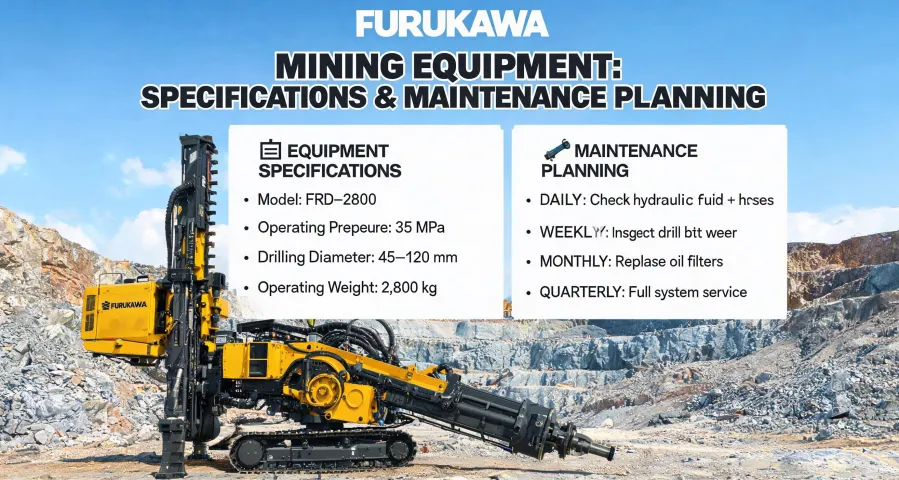
I don't buy equipment based on the lowest quote. Here's why.
In my role coordinating emergency parts and equipment for mining and construction projects, I've seen a lot of deals fall apart. The one thing that consistently costs my clients more money? Chasing the cheapest initial price. I'm not talking about a few dollars on a pencil. I'm talking about tens of thousands of dollars on hydraulic breakers, specialized batteries, and fiber optic cable runs.
My view is pretty simple: When you need equipment delivered yesterday, buying for value—not price—is the only way to survive. I've learned this the hard way, and I'm going to show you exactly how the math works out with real-world examples involving Furukawa equipment.
The hidden math of a 'cheap' breaker
Let's talk about hydraulic breakers. Say you're a demolition contractor on a tight timeline. A major Furukawa breaker is quoted at $12,000. A competing, lesser-known brand is quoted at $8,500. Your purchasing manager is looking at that $3,500 savings.
But here's what that savings doesn't include. I've seen a 'budget' breaker fail on the second job. The seals blow, or the piston cracks. Now you're looking at a $2,500 repair bill plus three weeks of downtime. While that machine is down, you're paying for the excavator it's mounted on (which is probably still on your rental bill). You're paying for the operator. You're paying for the lost productivity on a contract with a $10,000-a-day penalty clause. That 'savings' of $3,500 disappears into a $15,000 loss. (Not that I've seen this happen; I've seen it happen more times than I can count.)
In my experience managing over 200 rush orders in the last five years, the lowest quote has cost us more in roughly 60% of cases. That's not a guess—that's from our internal project tracking data (circa 2024).
When the battery dies, the whole site stops
Another example: batteries. I get why people look for the cheapest car battery for their fleet vehicles. But for industrial equipment, mining vehicles, and critical backup power systems? A cheap battery is a gamble.
I had a client call me in March 2024, 36 hours before a major safety audit. They needed a specific set of Furukawa FTX9-BS batteries for their backup power system for the emergency lighting. A regular, cheaper brand was in stock, but the specs were slightly different. The client's partner wanted to save $200. I told them, 'Don't do it.' We went with the Furukawa battery because the voltage and cold cranking amps were a perfect match for their system. During the audit, the backup system had to run for three hours. The cheaper option would have failed at hour two. That $200 'savings' would have cost them the audit.
To be fair, the cheaper battery would have worked in a standard truck. But for that specific, critical application? It was a deal-breaker. The reliability of the Furukawa product (and I know this from their published specs and from using them for years) translated directly into a successful audit.
Fiber optics: The cable that doesn't make you guess
Same story with fiber optic cable. When you're pulling cable for a data center or a long-haul network, the price difference between a budget spool of CAT6 and a Furukawa CAT7 is noticeable. The cheaper stuff might be 25% less expensive. But I've seen what happens when budget cable gets installed. Attenuation is higher, crosstalk appears, and the network doesn't hit its speed targets.
The total cost of that isn't the cable. It's the technician's time troubleshooting the runs. It's the time spent re-terminating the ends. It's the lost revenue from a slow new network. A spool of Furukawa CAT6a fiber cable costs more, but you don't question the signal loss. You just know it meets the spec. It's one less thing to worry about when you're managing a race to a deadline.
The value of 'it just works'
I get why people go for the cheapest option—budgets are real. And grant it, sometimes a cheap item works fine for a non-critical application. But when the project has a hard deadline, a penalty clause, or a safety component, the decision isn't about the purchase price. The decision is about the total cost of ownership. It's about the cost of a failure.
I went back and forth between a quality vendor and a discount one for about two weeks for a critical part. The discount vendor offered a 30% saving on a Furukawa piston. The established vendor offered the exact OEM part. On paper, the discount made sense. But my gut said the risk of an aftermarket part failing was too high. I chose the OEM part. The project delivered on time. The discount vendor's part? I later heard from a colleague that a similar aftermarket part failed in the first month.
So, bottom line: Don't ask me for the cheapest price. Ask me for the best value. For my money, and for the reliability of my projects, that's almost always Furukawa.