Which Furukawa Product Do You Actually Need? A Quality Inspector's Scenario Guide
Here's the honest truth: there's no universal "best" Furukawa product. If anyone tells you otherwise, they're either trying to sell you something, or they haven't spent enough time watching how these products actually perform in the field.
I'm a quality compliance manager at Furukawa—three years in this role, and four years before that in supplier quality for a mining equipment dealer. Between the two jobs, I've personally reviewed something like 8,000 individual products: hydraulic breakers, industrial batteries, fiber optic cable drums, thermal management components. In 2024, I rejected roughly 6% of first production batches for spec deviations. That's not because our production partners are sloppy—industrial equipment is genuinely hard to make right, and it's even harder to confirm it's right before it ships.
The biggest lesson from all those inspections: what you should buy depends entirely on what you're going to do with it. So let me lay this out the way I talk to customers who sit across my desk. I see three main scenarios, and each one points to a different product family and a different specification priority.
Scenario A: You're breaking rock—mining, quarrying, demolition
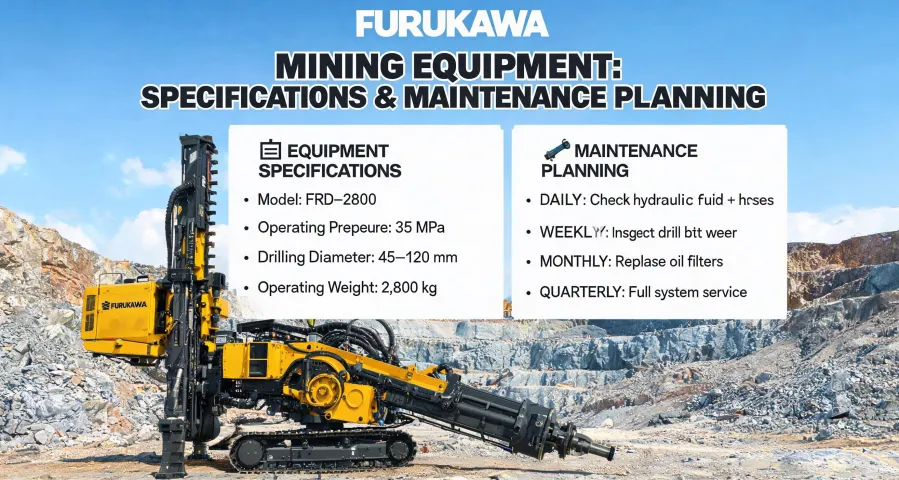
If you're running an excavator in a quarry or on a demolition site, you're probably looking at Furukawa hydraulic breakers. This is our most visible product line, and also where I see the most expensive mistake.
The mistake? Buying the biggest breaker your budget allows.
I understand the instinct. More impact energy should mean faster breaking, right? Sometimes. But if the breaker is too heavy for the carrier—the excavator it's mounted on—you get inefficient energy transfer, excessive vibration, and premature wear on both machines. In early 2024 we ran a side-by-side test: same rock, same operator, two breakers—one at 90% of the carrier's recommended max weight, one at 110%. The oversized unit produced 15% less breaking output per hour and burned more fuel doing it. Bigger isn't automatically better.
Spec tip: match the breaker class to your carrier's operating weight and hydraulic flow. Furukawa publishes these ranges for every model. If the carrier's hydraulic flow exceeds what the breaker is designed for, you need a flow limiter. If it's below spec, you'll get weak, inconsistent blows. Either way, you'll blame the breaker, but the data will point at the matching.
Quality note: when we audit breaker production batches, the most common spec deviation we catch is mounting pin tolerance. Pins are supposed to be within ±0.05mm of nominal. In Q3 2024 we rejected a batch where the pins were 0.2mm off—visible to the naked eye if you knew what to look for. Doesn't sound like much, but at 600 blows per minute, a sloppy pin fit accelerates bushing wear and eventually cracks the bracket. When you're buying a breaker, ask how pin tolerances are verified. "They're made to spec" isn't an answer. You want to hear about a CMM report or a pin gauge check.
And if a distributor tells you a breaker is "the most productive in its class," ask what that claim is based on. Per FTC advertising guidelines, performance claims need to be substantiated with evidence. We publish test data for our breakers. A distributor who can't produce comparable data isn't giving you information—they're giving you marketing.
Scenario B: You need reliable power—industrial, automotive, or backup systems
The second most common scenario is batteries. Furukawa's line covers automotive starting batteries (the FTX series), industrial stationary batteries for telecom and backup, and motive power batteries for forklifts and other electric vehicles.
The most common mistake here: choosing purely on ampere-hour capacity.
Capacity is important, but the bigger question is whether the battery is built for your type of duty. There are two fundamentally different kinds of service:
- Float service: the battery sits on charge nearly all the time, providing backup when the grid fails. UPS, telecom, emergency lighting.
- Cycle service: the battery is regularly discharged and recharged. Forklifts, floor scrubbers, off-grid solar.
A cycle-service battery left in float at the wrong voltage will fail prematurely. Put a float-service battery in heavy cycling duty, and you might get a few weeks before it gives up. They're engineered differently for a reason.
Here's where I have to be careful: I'm not a battery engineer, so I can't walk you through the electrochemistry. What I can tell you from a quality perspective is that thermal management is the silent killer of batteries. Every battery has a rated operating temperature range, usually printed right on the spec sheet. In 2023, a customer complained about a bank of stationary batteries failing after 18 months. They should have lasted eight years or more. Our engineers visited the site and found the battery room's HVAC had been switched off to save power during a heatwave. The batteries were running at 40°C instead of 25°C. Float voltage was in spec, but the heat was boiling the electrolyte. That "saving" cost $14,000 in replacement batteries and a week of downtime.
The thermal factor
Furukawa Electric's thermal research shows up directly in how we validate battery performance. The same team that develops thermal management products—heat sinks, thermal interface materials—helped define our elevated-temperature testing procedures. Battery life and temperature are inseparable, and anyone who tells you otherwise is selling something.
Spec tip: tell your supplier exactly how the battery will be used and where it will be installed. If your battery room regularly hits 35°C, you need a battery rated for that—or you need to fix the room first. And always check your charger's float voltage against the manufacturer's recommendation. That 30-second check has saved customers thousands of dollars.
There's something genuinely satisfying about seeing a battery system reach its design life. We had a telecom installation from 2018 that was still above 80% capacity as of late 2024. No heroics—just the right battery for the job, correct float voltage, and a room that didn't bake the electrolyte.
Scenario C: You need connectivity—fiber optic infrastructure
The third scenario is fiber optic cable. This is Furukawa Electric's heritage—we've been making optical fiber since the 1980s—and it's a different kind of buying decision. If you need a breaker, you know exactly what it's for. With fiber, the "right" cable depends heavily on the installation pathway, and the most common mistake is over-specifying.
People buy armored outdoor cable for indoor runs because they don't want to be the one who underestimated. I get it. Nobody got fired for buying too much cable. But you're paying for material and labor you don't need. A standard indoor cable with a fire-retardant jacket costs a fraction of armored cable per meter, and it's easier to pull, bend, and terminate. The "best" cable is the one that fits your actual pathway—not the one with the most impressive datasheet.
Three things that actually matter in fiber
- Installation pathway. Underground conduit, cable tray, direct burial, short patch between racks—each calls for a different jacket construction.
- Bend radius. Every cable has a minimum bend radius. Exceed it, and the glass micro-cracks—which shows up as increased attenuation, sometimes only months later.
- Pulling tension. In our quality audits, more than 30% of field failures in fiber turned out to be installation damage, not manufacturing defects. The cable shipped from our facility within spec. But the installer pulled too hard around a corner, and the damage didn't show until the cable had been through a year of thermal cycling.
Spec tip: run an OTDR test before and after installation. Most contractors only test after installation. A post-install test catches pulling damage, but it can't tell you whether the cable was compliant when it left the factory. Pre-install testing on the drum gives you a baseline. It's not standard practice for most contractors as of early 2025—but it should be.
How to figure out which scenario you're in
If your situation doesn't fit neatly into one of these three, walk through these questions:
- What's your operating environment? Heavy vibration, rock, and dust → Scenario A. Temperature-controlled and stationary → Scenario B. Conduits, trays, or trenches → Scenario C.
- What's your duty cycle? Hammering rock eight hours a day means serviceability matters more than peak impact energy. A battery on standby means float voltage matters more than capacity. A cable that never moves after installation means bend radius matters less than pull tension during installation.
- What does failure cost you? This is the question people skip. If a breaker fails, you lose a day of production. If a battery bank fails, you lose data or emergency response capability. If a fiber link fails, you might lose connectivity for an entire facility.
The cost of failure should drive your spec decisions—not just the price tag of the equipment.
If you're still not sure, that's genuinely fine. This gets into application engineering territory, which isn't my day job. I'd recommend sitting down with a Furukawa distributor or a manufacturer's rep and giving them the answers to the three questions above. An informed customer asks better questions, and better questions lead to better recommendations.
One final note from my side of the inspection table: get the warranty terms in writing and read the conditions carefully. We stand behind our products, but warranty claims go smoother when both sides know exactly what's covered—and what's excluded. In 2022, I implemented a documentation verification protocol for outgoing shipments that cut warranty disputes by about a third. It's the simplest, most boring improvement we've made, and it saves real money for everyone involved.
This guidance reflects what I know as of early 2025. Product lines and specifications evolve, so verify current details with your supplier before making a final decision.