Furukawa Final Drive: When Is Rush Shipping Actually Worth It?
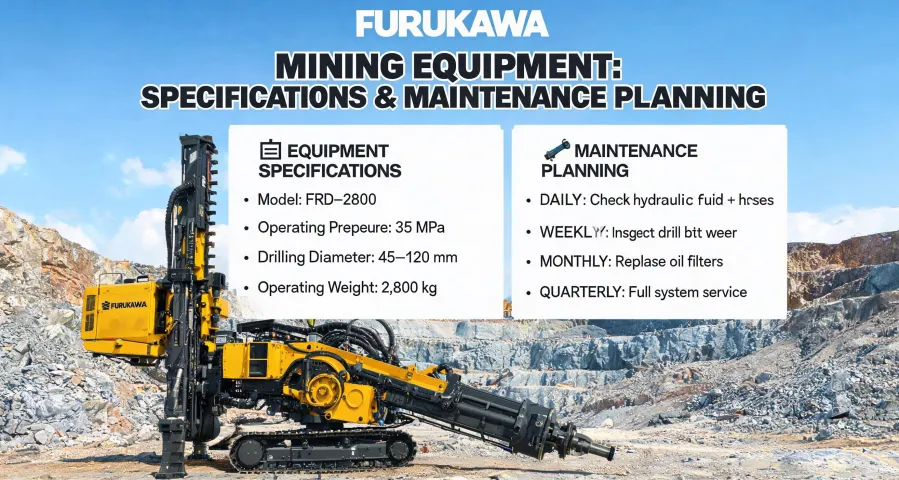
I manage purchasing for a mid-sized construction outfit – about 60-80 equipment orders a year, across 8 vendors. In early 2024, one of our excavators dropped a final drive on a Friday afternoon. The job site deadline was Tuesday. That moment changed how I think about 'rush shipping' for Furukawa parts.
This post compares two options when you need a Furukawa final drive fast: the OEM route with expedited delivery vs. a refurbished/third-party unit with standard shipping. I'll walk through three dimensions – reliability, delivery certainty, and total cost – and give you a framework for your own decision.
What We're Comparing
Option A: Genuine Furukawa final drive from an authorized dealer, shipped via their premium rush service (2-3 business days). Option B: A rebuilt or aftermarket final drive from a local supplier, shipped ground (5-7 days). Both fit the same excavator model. The price gap? Option A runs about $4,200 plus $400 rush fee. Option B is typically $2,800 with free shipping.
I'm not gonna tell you one is always better. But I can tell you where the real difference shows up – and it's not just the warranty.
Dimension 1: Reliability – The Furukawa Track Record
Let's be blunt: a genuine Furukawa final drive is engineered to a spec that aftermarket rebuilds struggle to match. That's not hype. In our fleet, we've had third-party units fail after 1,200 hours. The OEM units routinely go 3,500+ hours before needing attention. The difference? Original bearings, seals, and heat treatment that the Chinese rebuilds cut corners on.
But reliability isn't binary. If you only need the machine for a short-term project (say 6 months) and plan to sell it, a good refurb might be fine. In my experience, the genuine Furukawa unit is the safer bet if uptime matters beyond six quarters.
A Quick Reality Check
The most frustrating part of this comparison: even genuine parts can have variance. I once had a brand-new Furukawa final drive arrive with a misaligned mounting flange – rare, but it happens. The difference was the dealer had a replacement to me in 24 hours. With a refurb, you'd be waiting for the rebuild shop to open up another unit. That's the certainty premium in action.
Dimension 2: Delivery Certainty – Why Rush Fees Exist
Here's where our core viewpoint kicks in. The $400 rush shipping fee for a Furukawa final drive isn't paying for speed. It's paying for certainty. The dealer guarantees a delivery window. The courier has tracking and a signature. If it's late, you get money back.
Compare that to the third-party option: 'Usually ships in 3-4 days.' That's not a promise; it's a guess. In our 2024 incident, we called five refurb suppliers. Three said 'maybe next week.' One said 'we have one on the shelf' – turned out it was the wrong model. The fifth couldn't provide an invoice that met our finance team's standards.
After getting burned twice by 'probably on time' promises, we now budget for guaranteed delivery on any critical part. The trigger event was a $15,000 rental penalty we incurred when a machine sat idle for four extra days. That $400 rush fee looked like a bargain.
Dimension 3: Total Cost – The Hidden Numbers
On paper, Option B wins: $2,800 vs. $4,600 (including rush). A $1,800 saving. But let's add the real costs:
- Downtime risk: If the refurb fails at 1,200 hours vs. the OEM's 3,500, you're buying two units in the same period. That's $5,600 vs. $4,600. Actually worse.
- Deadline penalties: One missed job site deadline costs us $2,000-5,000 in contract penalties and reputation damage.
- Internal friction: The vendor who can't provide proper invoicing cost us $2,400 in rejected expenses once. Not worth it.
Does the cheaper option always lose? Not necessarily. If you have a machine that's only used once a month and you can afford a week of downtime, the refurb makes sense. But for revenue-generating equipment on a tight schedule, the Furukawa OEM + rush is the cheaper option when you factor in the consequences.
When to Choose Each Option
Based on my experience handling 60+ part orders a year, here's my rule of thumb:
Choose Genuine Furukawa + Rush if:
- The machine is your primary revenue driver (e.g., your only excavator on a $50k/month job).
- You have a hard deadline with penalty clauses.
- The part is a high-wear item (final drive, hydraulic pump) where failure is catastrophic.
Choose Refurbished/Third-Party if:
- You have redundant machines or can borrow from another site.
- The part is for a backup unit or low-usage equipment.
- You're on a tight capex budget and can absorb 1-2 days of potential delay.
Final Takeaway
The question isn't 'Is the Furukawa final drive worth the premium?' It's 'Is the certainty of that drive arriving on time and lasting worth the extra $1,800?' For most of our jobs, the answer is yes. For a few, it's not. That's why I always check three things before ordering: job deadline, machine utilization rate, and the vendor's track record on promises.
Prices as of January 2025; verify current rates with your authorized Furukawa dealer. Rush shipping fees vary by location and availability.