Furukawa FAQ for Equipment Buyers: What to Check Before Ordering a Breaker or Rock Drill
-
The Furukawa questions that have saved us the most money
-
1. Is Furukawa one manufacturer or several?
-
2. How do I choose the right Furukawa breaker for my excavator?
-
3. Do I need a breaker or a drifter?
-
4. Should I buy new or rebuilt?
-
5. How do I know replacement parts are genuine?
-
6. What should I check when the breaker arrives?
I've been handling equipment sourcing for a tunneling and site-works contractor since 2017. I've also made enough expensive mistakes to total roughly $28,000 in wasted budget—replacement parts, repairs, rework, and downtime. That's why I now keep a written checklist. These are the Furukawa questions I think any buyer should answer before ordering, not after.
One honest limitation before I start: I'm not a hydraulic engineer. I can't tell you how to rebuild a cylinder or how to set nitrogen pressure from memory. What I can tell you is what to verify, what to get in writing, and where I personally got burned.
The Furukawa questions that have saved us the most money
- Is Furukawa one manufacturer or several?
- How do I choose the right breaker for my excavator?
- Do I need a breaker or a drifter?
- Should I buy new or rebuilt?
- How do I know replacement parts are genuine?
- What should I check when the machine arrives?
1. Is Furukawa one manufacturer or several?
Furukawa is a group name, not a single product line. You'll see Furukawa Electric for optical fiber, cable, and wire; Furukawa Battery for automotive and industrial batteries; and Furukawa Rock Drill for hydraulic breakers, rock drills, and attachments. They share a name and a history, but they operate as separate businesses with separate support channels.
I learned this the slow way when a colleague called the cable side of the business for help with a breaker attachment. Wrong queue, obviously. The lesson: before you place an order, confirm which product division you're dealing with and who actually honors the warranty. It sounds basic, but I've seen the confusion cost people a week of waiting.
2. How do I choose the right Furukawa breaker for my excavator?
Don't choose by excavator model alone. In 2019, I picked a breaker based on the carrier's weight class and skipped the hydraulic specs. The machine's auxiliary circuit delivered more flow than the breaker was rated for, and we found out about 40 hours in. The repair cost roughly $3,100, and the excavator sat for nine days—or rather, ten by the time the part arrived.
Now I ask for five numbers before I'll approve any quote:
- Carrier operating weight class
- Hydraulic flow range in L/min or gpm
- Operating pressure range in MPa or psi
- Bracket and pin dimensions
- Tool diameter and working length
A fifteen-minute check against the spec sheet would have prevented the whole incident. Five minutes of verification still beats five days of correction.
3. Do I need a breaker or a drifter?
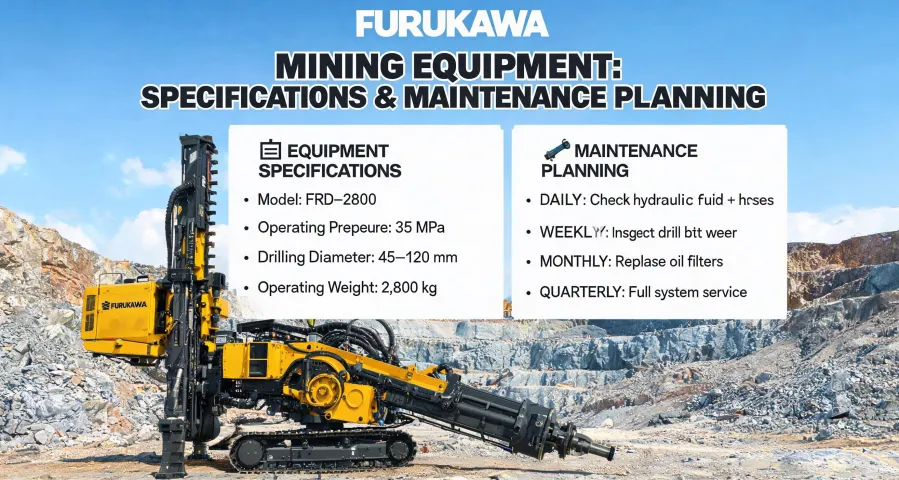
The word drift confuses a lot of people, because in everyday language it sounds like snow or skidding. In mining, though, a drift is a horizontal underground passage. If you're working in a drift and need to drill blast holes, you need a drifter—a hydraulic rock drill mounted on a drill rig. If you're breaking oversize rock or concrete on the surface, you need a breaker.
They're not interchangeable. A breaker smashes material that's already loose or blocky; a drifter drills holes into the rock face. When a supplier quote doesn't clearly tell me which one is being supplied, I treat that as a red flag. The word drift should appear in the application notes if the unit is meant for underground development work.
4. Should I buy new or rebuilt?
I went back and forth on this for a while. For our main fleet, where a breaker is on an excavator six to eight hours a day, I generally buy new. The warranty and predictable wear parts are worth it. But for a branch that only does seasonal work, a rebuilt unit made more sense financially.
I chose rebuilt in that case, but only because the rebuilder showed me a work order with the replaced parts, seals, and clearances documented, and put the warranty in writing. Without that paperwork, you're buying someone else's uncertainty. Rebuilt isn't automatically bad; it's automatically riskier if the seller won't show their work.
5. How do I know replacement parts are genuine?
Use the serial number, not the model name. In March 2022, I ordered a piston assembly that matched the exploded diagram perfectly. It didn't fit, because Furukawa had made a revision and the part number carried a suffix I hadn't verified against the actual unit. I still kick myself for that one. It was about $740 in parts plus a week of waiting.
Now I check the serial number prefix against the official parts catalog before ordering anything. If a listing says fits Furukawa but the seller won't confirm the serial number application in writing, I move on. Genuine doesn't mean compatible with your revision; verified does.
6. What should I check when the breaker arrives?
One delivery looked perfect on the outside. We signed the paperwork, and only the next morning noticed that the serial number on the unit didn't match the packing list. It turned into a dispute we didn't need. Now the delivery check is simple:
- Serial number on the unit matches the invoice, packing list, and certificate of origin.
- Mounting pins, bushings, and bracket dimensions match the order.
- No visible oil leaks around the front head or hoses.
- Check the nitrogen precharge according to the service manual before mounting. I won't give you a number here because it varies by model and temperature.
- Photograph everything before signing, especially if something looks wrong.
That mismatch check alone caught eighteen issues in the first eighteen months. None of them were expensive, but all of them were fixable before the unit went to work. A twenty-minute walk-around is the cheapest insurance I've found, and it's the one step I won't skip anymore.